An adventure that grows with you
Play with an idea. Then see the math.
Choose a learning stage from Pre-K to introductory college explorations. Younger children count, combine and remove objects, match shapes, and set clocks through game interactions. Older students connect their answers with changing models, equations, and graphs.
Original woodland friends bring gentle humor to early adventures. The presentation becomes more mature for later stages, and a quieter view is always available. Missions have a clear finish, free hints, and no speed penalties. Collect pretend coins to choose pets, habitats, cases, keychain charms, and imaginary snacks. Pets stay safe when you take a break.
This is a growing set of selected explorations, not a complete Pre-K-to-college curriculum. Journey and collection data stay in this browser; there are no accounts or classroom tracking services.
Find what you are learning at school
A grade. A topic. One little discovery.
The adventure has 271 missions with 813 short challenges. Grades K–5 have connected journeys with flexible pacing and review. Choose a grade, then a topic. Kindergarten has 39 activities, Grade 1 has 36, and Grade 2 has 37, each in six connected units with visual teaching and planned review. With Grade 3 and all topics selected, 76 activities form an eight-unit journey across 36 flexible study weeks. Grade 3 has separate multiplication and division paths: equal groups, arrays, skip-counting, useful fact strategies, fair shares, missing factors, and checking an answer by multiplying back.
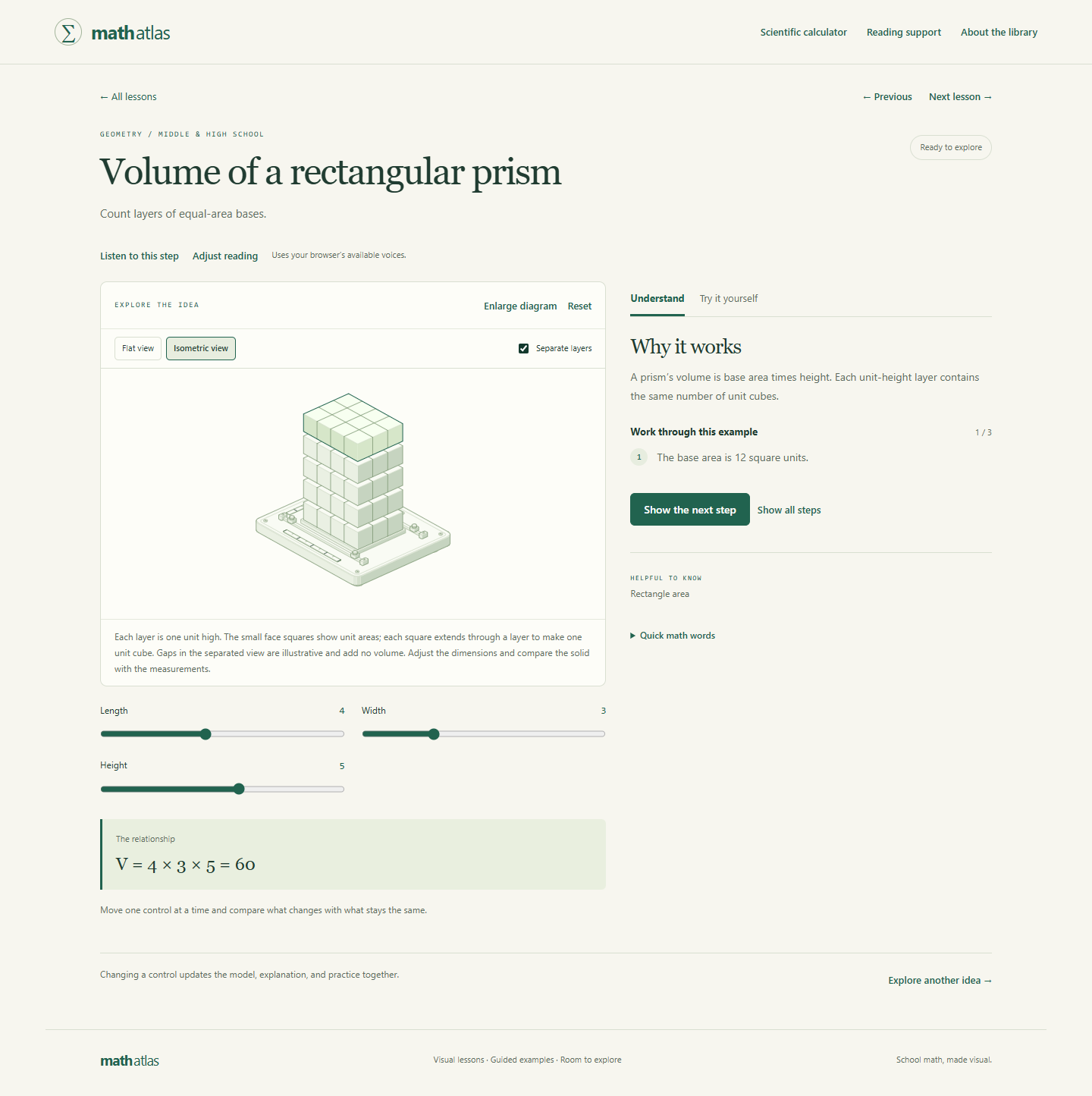
Grades 4 and 5 each have eight connected units and 32 new original lessons: 192 additional challenges in larger-number operations, fractions, decimals, measurement, shape reasoning, coordinates, expressions, and volume. Grade 4 offers 46 activities and Grade 5 offers 35 including review. Explore equal-whole fraction bars, decimal grids, partial-product models, angle tools, coordinate plots, and cube layers. See the Grades 4–5 family guide.
The K–2 journeys add 72 original activities with ten-frames, teen bundles, equal-unit measurement, shape building, fair shares, and labeled U.S. coins and bills. All K–2 answers use picture controls or choices. Start with an example together, then let the learner build and explore. See the K–2 family guide and grade-by-grade coverage review.
The Grade 3 journey adds 36 original activities on place value and regrouping, multiplication and division strategies, fractions on number lines, time, measurement, graphs, and geometry. Open “Our lesson” for a goal, a worked example, helpful earlier ideas, and a little review. Units suggest familiar ways to draw, build, and explain the math. See the Grade 3 family guide.
Grade 3 division answers can be built right in the picture. Large + and − buttons add or remove equal rows, or change the share in every row. The total changes with each tap; checking uses the built model, without requiring a typed number.
Grade labels are starting points, and topics can overlap grades. High-school sequences vary. The activities link to relevant Common Core topic codes where useful; this growing collection does not cover every standard or replace a complete course.
The sequence is independent and connected to the relevant grade-level standards. It can support schoolwork from programs such as those from Curriculum Associates; it does not claim to match a particular product, edition, or school pacing guide.
Open classroom materials
Four Grade 3 activities adapt the learning structures of the first edition of IM K–12 Math, © 2021 Illustrative Mathematics®, licensed under CC BY 4.0. Changes include shorter instructions, original interactive art, new examples and stories, and individual play. Source details are available inside each adapted activity. Math Atlas is an independent project.
These links open the original classroom resources. Only the four credited Grade 3 adaptations are included in the game. The original publisher's logos, photographs, and restricted teacher answers have not been imported.
How materials are selected and connected to schoolwork →Bring a problem from school
The equation entry accepts ax + b = c, using whole-number a from 1–6, b from −6–6, and c from −20–30. For example, 3x + 4 = 16 opens a worked lesson with that equation.
This entry is a bounded equation helper, not an unrestricted solver. For other topics, choose the appropriate lesson and adjust its controls. Practice accepts numeric answers, fractions such as 3/4, and scientific notation such as 3e-5.
Built to grow carefully
What’s here—and what comes next
There are 80 interactive lessons in nine collections: number sense, ratios and percents, pre-algebra, Algebra I, geometry, Algebra II, trigonometry, statistics and probability, and advanced explorations. Six lessons offer Anatomy-style spatial models.
This edition explores major topics; it is not a complete, certified standards-aligned curriculum. Full proof and construction sequences, extended word-problem coaching, comprehensive inference, and deeper assessments still need development.
Math Atlas uses browser-local storage for progress and preferences. This version does not include built-in analytics or send practice answers to an application server. The hosting provider and browser may still process ordinary requests.
Explore the roadmap →
Credits & source
Created and maintained by dancinglumberjack, with room for a community of contributors. The application code is MIT licensed. Adapted educational activities retain their CC BY 4.0 attribution and reuse terms.
Spatial illustrations use the Anatomy toolkit by Ryan, also MIT licensed. Its attribution and license are preserved in the repository and generated app. See third-party notices for details.
Browse the source, documentation, and tests →